

An A/C expansion valve can fail in two directions, and they are opposites. Stuck closed, it starves the evaporator. Stuck open, it floods it. The driver usually says the same thing either way (“it’s not cold”), but your gauges and the frost on the lines tell two completely different stories. This guide shows you how to read them, how to rule out the look-alikes, and what to replace when the valve really is the problem.
Bad expansion valve symptoms at a glance
A valve that is stuck closed or plugged shows a low-side reading that is low or pulling into a vacuum, a high side that is low to normal, frost at the valve or evaporator inlet, and warm vents. A valve that is stuck open shows a high low-side reading, a high side that is normal to high, a suction line that is cold, sweating, or frosted all the way back to the compressor, and vents that are cool but never cold.
| Stuck closed (starved) | Stuck open (flooded) | |
|---|---|---|
| Low-side gauge | Low, may pull into a vacuum | High |
| High-side gauge | Low to normal | Normal to high |
| Frost or sweat | At the valve or evaporator inlet | On the suction line, back toward the compressor |
| Evaporator outlet line | Warm | Very cold |
| Vent air | Warm or barely cool; may come and go | Cool, never cold; worst at idle |
| Compressor | Clutch may short-cycle; runs with little oil return | May be noisy; risk of liquid reaching it |
| Most often mistaken for | Low refrigerant charge | Weak compressor or overcharge |
In this guide: What the valve does · Stuck closed vs. stuck open · Look-alikes · Step-by-step diagnosis · Why valves fail · Orifice tube systems · The fix · Find the right valve · FAQ
What an expansion valve actually does
The thermostatic expansion valve (TXV) sits at the evaporator inlet, usually at the firewall. It has one job: meter exactly as much liquid refrigerant into the evaporator as the evaporator can boil off. Too little and most of the coil does no cooling. Too much and liquid comes out the other end, which does no cooling either and is dangerous for the compressor.
It does this by balancing forces on a diaphragm. A sensing bulb (or, on a block valve, a passage through the valve body) reads the temperature of the refrigerant leaving the evaporator. When that outlet gets warmer, the evaporator is running out of liquid too early, so pressure on top of the diaphragm rises and pushes the valve open. When the outlet gets colder, the valve closes down. A spring and the evaporator’s own pressure push back from below.
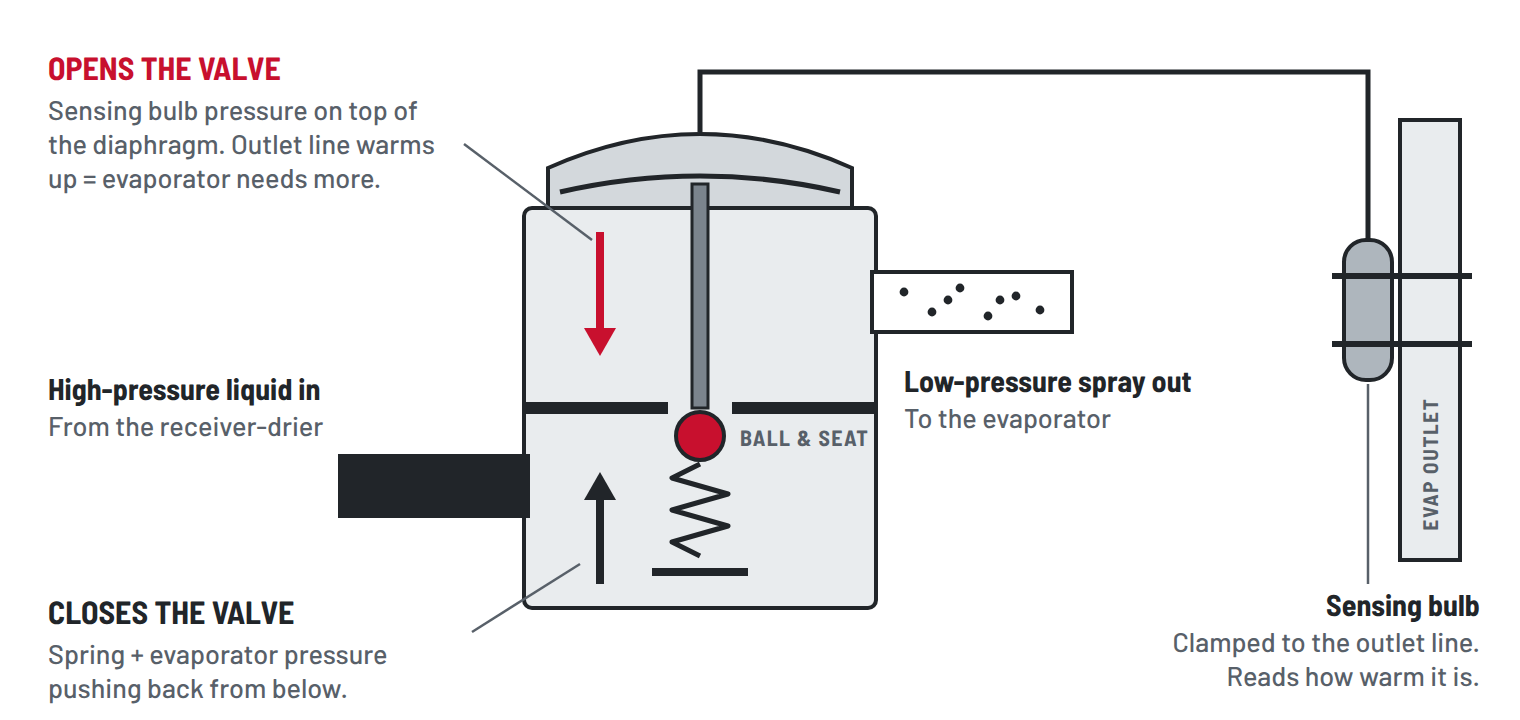
Everything that goes wrong with a TXV comes down to that balance failing. If the valve cannot open (plugged, seized, or no pressure from the bulb), the evaporator starves. If it cannot close (seized open, or a bulb that is reading warm air instead of the pipe), the evaporator floods.
Stuck closed vs. stuck open
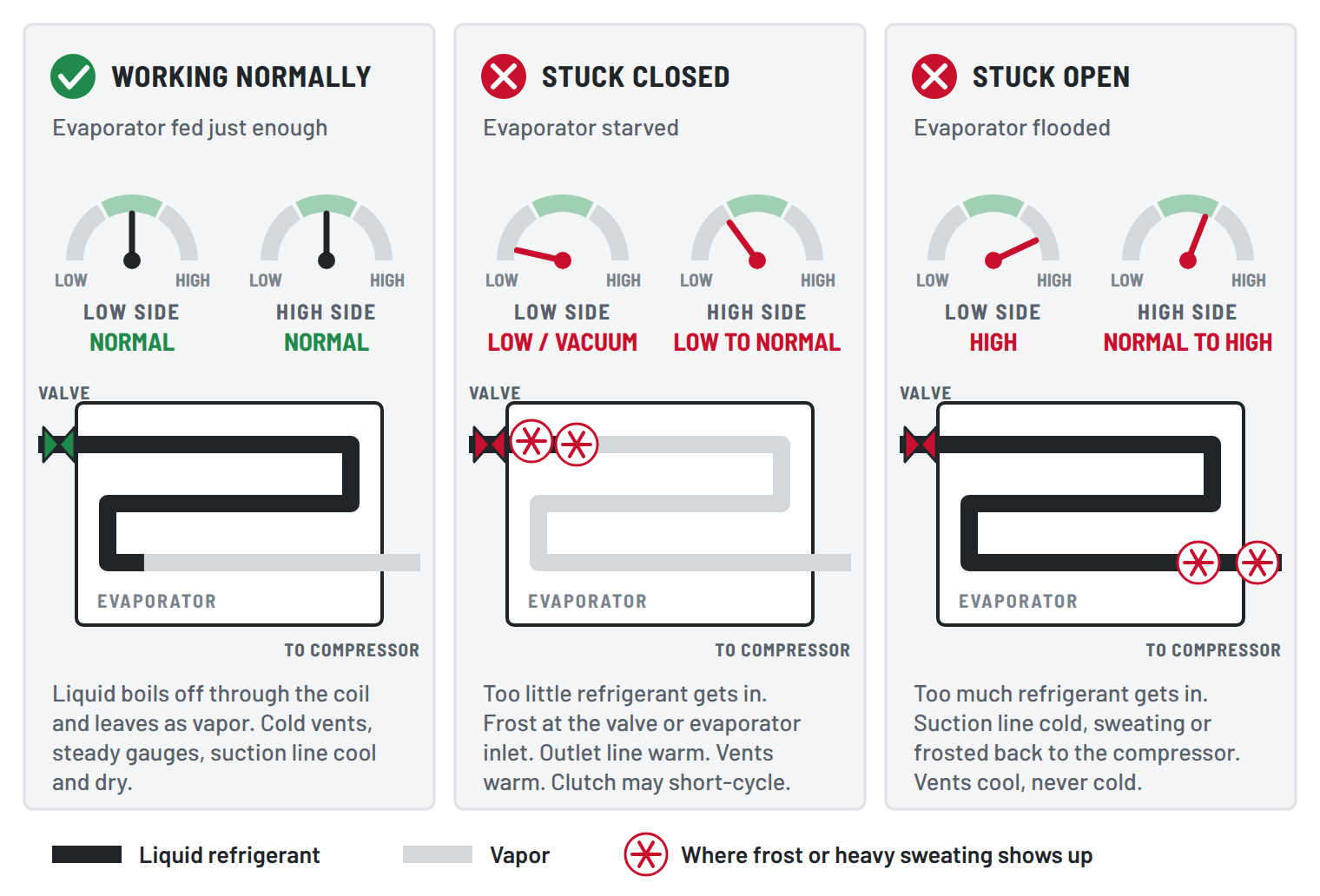
Stuck closed or plugged: the starved evaporator
Little or no refrigerant gets past the valve. The compressor keeps pulling on the low side, so low-side pressure drops, sometimes into a vacuum. With so little refrigerant circulating, the high side has nothing to build pressure with and sits low to normal.
- Vents are warm or barely cool. Only the first few inches of the evaporator are doing any work.
- Frost or heavy sweating right at the valve or the evaporator inlet pipe. The pressure drop is happening at the restriction, so that is where the cold is.
- The evaporator outlet line is warm. Whatever refrigerant got in boiled off long before the outlet.
- The clutch may short-cycle as the low-pressure switch trips, resets, and trips again. On variable-displacement compressors without a cycling clutch you will not see this.
- Cooling that comes and goes. Cold for ten or twenty minutes, then warm, then cold again after the car sits. That pattern is moisture freezing at the valve, thawing, and freezing again. The valve may be fine; the system is wet.
Why this one hurts compressors quietly. Compressor oil travels around the system with the refrigerant. When the valve chokes off the flow, the oil stops coming back too, and the compressor runs hot and under-lubricated. Do not keep running the A/C “to see if it clears up.”
Stuck open: the flooded evaporator
The valve lets in more liquid than the evaporator can boil. Evaporator pressure rises, and with it evaporator temperature, so the air coming off the coil is cool at best. The surplus liquid carries on out of the evaporator and down the suction line.
- Vents are cool, never cold, and usually worst at idle and in traffic.
- Low-side pressure is high. The high side is normal or somewhat high. It is not low, and that detail matters in the next section.
- The suction line is very cold, sweating heavily, or frosted, sometimes all the way to the compressor body. That is liquid refrigerant boiling off in the hose, where it does you no good.
- The compressor may knock or sound harsh. Compressors pump vapor. Liquid does not compress, and slugging can damage reed valves and pistons.
On a capillary-tube valve, a “stuck open” symptom is often not the valve at all. A sensing bulb that has come loose, lost contact with the pipe, or lost its insulation reads warm under-dash air instead of the cold outlet line. It tells the valve to open, and keeps telling it.
Look-alikes: gauge patterns that fool people
Expansion valves get replaced for a lot of problems they did not cause. These are the patterns worth ruling out, and the one observation that separates each from a bad valve.
| Low side | High side | Likely cause | How to tell |
|---|---|---|---|
| Low | Low | Low refrigerant charge | No frost concentrated at the valve. Recover and weigh the charge. This is far more common than a bad valve. |
| Low / vacuum | Low to normal | Valve stuck closed or plugged | Charge is correct, and the frost or cold spot is right at the valve or evaporator inlet. |
| Low / vacuum | Low to normal | Restriction elsewhere on the high side | The frost or sharp temperature drop is at the drier, a kinked liquid line, or a plugged condenser pass, not at the valve. |
| Swings between normal and vacuum | Follows it | Moisture freezing at the valve | Cooling returns after the system rests. Replace the drier and evacuate thoroughly. |
| High | Normal to high | Valve stuck open (or bulb loose or uninsulated) | Suction line very cold, sweating, or frosted back toward the compressor. |
| High | Low | Weak compressor or failed compressor control valve | Pressures sit close together and the suction line is not unusually cold. |
| High | High | Overcharge, poor condenser airflow, or air in the system | No frost on the suction line. Check fans, condenser fins, and charge weight first. |
“Low,” “normal,” and “high” always mean relative to the manufacturer’s pressure chart for that vehicle at that day’s ambient temperature and humidity. We have deliberately not printed PSI numbers, because a reading that is normal at 70°F is a fault at 100°F.
On vehicles with a variable-displacement compressor, a failed compressor control valve is a common cause of the “low side high, high side low” pattern, and it is a far easier repair than a compressor.
How to diagnose a bad expansion valve
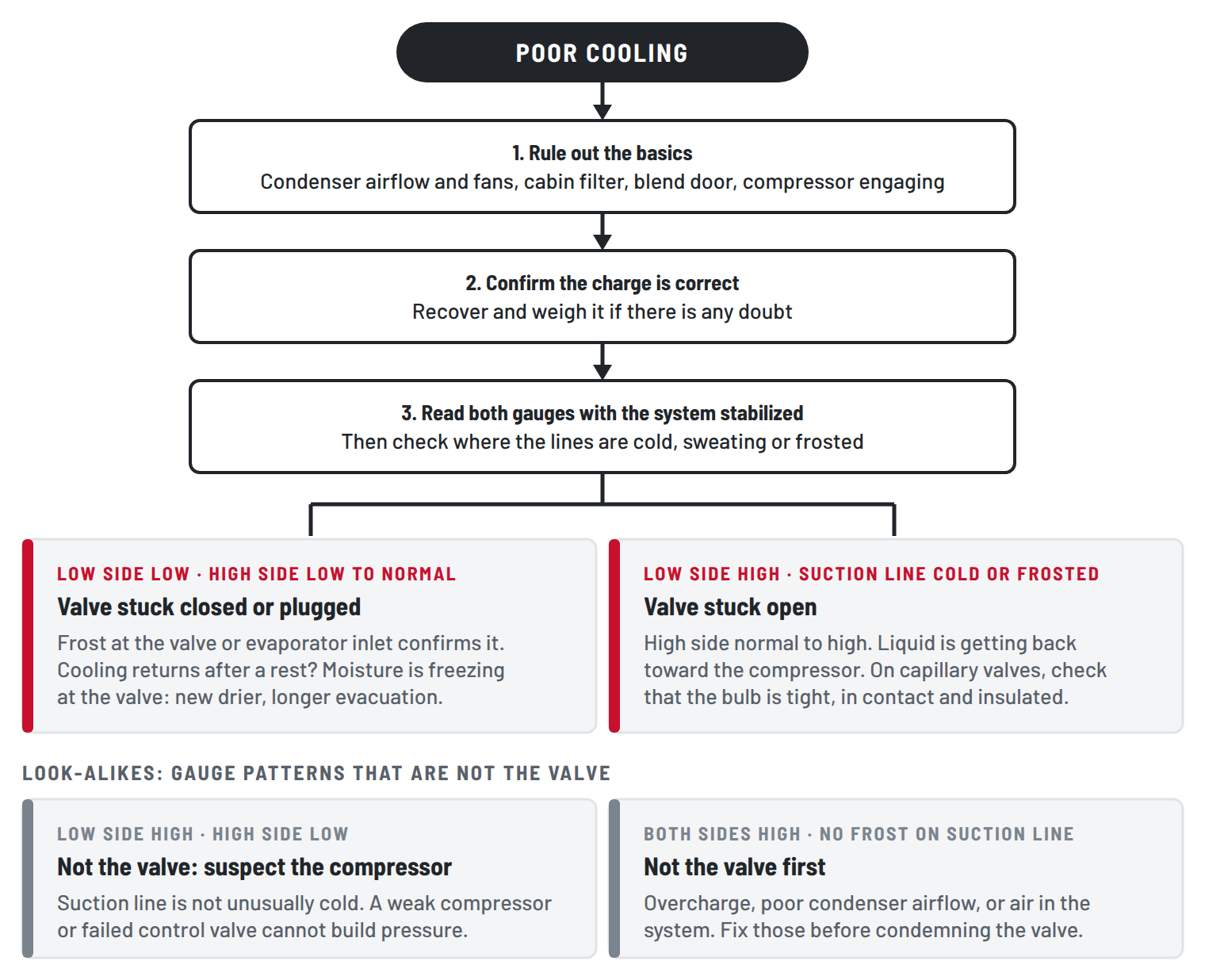
1. Rule out the basics
Confirm the compressor is actually engaging, the condenser fans run, the condenser fins are not packed with debris, the cabin filter is not plugged, and the blend door is not mixing in heat. None of these is a refrigerant problem, and every one of them produces “not cold enough.”
2. Confirm the charge
Gauge patterns only mean something on a correctly charged system. If there is any doubt, recover the refrigerant, weigh it, and compare it with the vehicle’s specification. A low charge and a starved evaporator look alike on the gauges, and the charge is the far more likely of the two. Find and fix the leak before going further; UV dye and a light make short work of it.
3. Read both gauges with the system stabilized
Connect a manifold gauge set, follow the test conditions in the service information (typically doors open, maximum cooling, blower on high, engine at a fast idle), and let the system run for several minutes before you believe any reading. Watch whether the low side is steady or swinging.
4. Find the frost and feel the lines
This is the step that separates a valve from its look-alikes. With the system running, look at and carefully feel the lines around the valve and the evaporator.
- Frost or a sharp cold spot at the valve, with a warm evaporator outlet: the restriction is at the valve. Stuck closed, or its inlet screen is plugged.
- Frost or a temperature drop somewhere else on the liquid line (at the drier, or at a kink): the restriction is there, not at the valve.
- Suction line frosted or dripping wet back toward the compressor: the evaporator is flooding. Stuck open, or a bulb problem.
- Nothing unusual anywhere, and both pressures are high: look at condenser airflow and charge weight.
Keep hands, sleeves, and tools clear of belts and fans, and remember that the discharge line and condenser inlet are hot enough to burn.
5. On capillary-tube valves, test the bulb
If you can reach the sensing bulb, you can test the valve directly. With the system running and gauges connected:
- Warm the bulb in your hand. The valve should open and the low-side pressure should rise.
- Chill the bulb with ice or a cold, wet rag. The valve should close down and the low-side pressure should fall.
If the low side does not respond either way, the valve is seized or the bulb has lost its charge (a kinked or cracked capillary tube will do it; a valve with a dead bulb stays closed). If it responds normally, the valve works, so check how the bulb was mounted: clean pipe, tight clamp, full contact, and wrapped in insulating tape. Block valves have no external bulb, so this test does not apply to them.
6. Look at what comes out
When the valve is off the vehicle, look into its inlet. Gray or black sludge and metal flake means the compressor is coming apart and the valve is a victim, not the cause. Tan or white beads are desiccant from a ruptured drier. Either finding changes the repair from “a valve” to “a system.”
The tap test. A few light taps on the valve body with a screwdriver handle sometimes frees a sticking valve and the pressures snap back to normal. That confirms the diagnosis. It is not a repair: a valve that stuck once will stick again.
Why expansion valves fail
An expansion valve is a simple, durable part. When one fails, something else in the system usually killed it, and that something will kill the new valve too if it is not dealt with.
Moisture
Water in the system freezes at the valve, the coldest point in the circuit, and blocks it. Over time moisture also forms acids and corrosion that make the valve stick. The root cause is a saturated drier or a system that was left open.
Shop driers & accumulators →Debris
Metal and sludge from a wearing compressor, or desiccant beads from a ruptured drier, collect at the valve’s inlet screen and orifice because it is the narrowest passage in the system.
Shop flushing tools →Bulb problems
A kinked or cracked capillary tube loses its charge and the valve stays shut. A loose, dirty, or uninsulated bulb reads warm and holds the valve open.
Shop universal-fit valves →Wrong valve
A valve with the wrong capacity, the wrong equalizer type (internal vs. external), or the wrong connections will overfeed or underfeed from the first day, and no amount of charging fixes it.
See the dimension charts →Wear and corrosion
After enough years and heat cycles, the pin and seat wear, the spring relaxes, and internal corrosion makes the valve slow or sticky. High-mileage valves rarely fail cleanly; they get lazy.
Shop expansion valves →Sealers and wrong oil
Stop-leak sealers harden where they meet moisture, and the valve is a favorite place. Too much oil, or the wrong oil, can also gum up a valve. If a sealer has been used, assume the valve and drier are both done.
Find the leak instead: UV dye →If the vehicle has an orifice tube instead
Not every system has an expansion valve. Many vehicles, particularly older domestic cars and trucks, use a fixed orifice tube in the liquid line and control evaporator temperature by cycling the compressor. The quick way to tell them apart is to find the canister:
An orifice tube cannot stick open, because it has no moving parts. It can plug, and a plugged orifice tube looks just like a valve stuck closed: low side low or in a vacuum, high side low to normal, and frost at the restriction. Its screen is also the best evidence you will get about the compressor’s health. Browse orifice tubes.
Fixing it: replace, do not clean
Expansion valves are not serviceable. They cannot be reliably cleaned or adjusted in the field, and solvent flushed through one will not free it. When the diagnosis points to the valve, replace it, and replace whatever killed it.
Recover
Recover the refrigerant with the right machine for the refrigerant. Venting is illegal, and R-1234yf needs its own equipment.
Replace
New valve, new O-rings lightly oiled, and a new receiver-drier. Every time, no exceptions.
Flush if dirty
Debris at the old valve means flushing the lines, condenser, and evaporator. Never flush through the valve, drier, or compressor.
Evacuate & charge
Pull a deep vacuum, confirm it holds, and charge by weight to specification.
Details that prevent comebacks
- Match the valve exactly. Connection type, Size, equalizer type, and capacity all matter. For block valves, compare the old valve against our block valve dimension chart before ordering.
- Use new O-rings of the right material, coated with the system’s oil. R-1234yf systems have their own O-rings and seals; see all A/C O-rings.
- Mount a capillary bulb properly: clean, bare pipe; clamped tight with full-length contact; positioned as the service information shows; and wrapped in insulating tape so it reads the pipe and not the air around it. A careless bulb install turns a new valve into a “stuck open” valve on day one.
- Do not kink the capillary tube. Coil any excess in a gentle loop.
- If moisture was the cause, evacuate longer than you think you need to, with a good vacuum pump. Vacuum is what boils the water out.
- After a compressor failure, the valve gets replaced along with the compressor and drier. It is full of what the compressor shed. Our compressor replacement kits bundle the parts that should go in together.
- Leak-check before you charge. The method in our hose guide applies here too: dry nitrogen or an Air Source system, or a deep vacuum held for 30 minutes. See pressure-testing before refrigerant goes in.
R-1234yf vehicles. The failure modes and the diagnosis are the same. What changes is the equipment: recovery, charging, and identification gear made for R-1234yf, its own service ports, and its own O-rings. Many R-1234yf systems also route the liquid line and suction line through an internal heat exchanger, so expect line temperatures near it to differ from what you are used to on R-134a. See R-1234yf tools.
Expansion valves at Air Components
We list expansion valves by vehicle, including heavy-duty and agricultural equipment, plus universal-fit valves for custom and retrofit systems. If you are matching an unmarked valve, start with the dimension charts.
Block & OE-style valves
Search by make and model, including heavy-duty, off-road, and ag applications.
Shop all expansion valves →Universal-fit valves
Block and capillary-tube valves for street rods, engine swaps, cabs, and add-on systems.
Shop universal fit →Dimension charts
Block valve, male flare, male insert O-ring, and metric dimensions to identify what you are holding.
Open the charts →Not sure which valve you have? Call 480-507-2229 with the vehicle, or the measurements and connection types from the old valve.
Expansion valve FAQ
What are the symptoms of a bad A/C expansion valve?
What do the gauges read when an expansion valve is stuck closed?
What do the gauges read when an expansion valve is stuck open?
How do I tell a bad expansion valve from low refrigerant?
How do I tell a bad expansion valve from a bad compressor?
Why does my A/C blow cold, then warm, then cold again?
Where is the expansion valve located?
Can an expansion valve be cleaned instead of replaced?
Do I have to replace the receiver-drier when I replace the expansion valve?
Should I replace the expansion valve when I replace the compressor?
Is it safe to keep running the A/C with a bad expansion valve?
What is the difference between an expansion valve and an orifice tube?
Are expansion valve symptoms different on R-1234yf systems?
Get the right valve the first time
Expansion valves by vehicle, universal-fit valves for custom systems, and the driers, O-rings, and flushing tools that belong in the same repair. Tell us the vehicle or send us the old valve’s measurements and we will match it.
Shop expansion valvesDimension chartsThis guide is general technical information for qualified technicians and experienced DIYers. Always follow the vehicle manufacturer’s service information and pressure charts, and applicable refrigerant-handling regulations. Refrigerant must be recovered, not vented.