

A car’s air conditioner does not make cold. It moves heat: it picks heat up inside the cabin and dumps it in front of the radiator, over and over, using a refrigerant that changes between liquid and vapor as it goes around a sealed loop. Every component in the system exists to move that refrigerant, change its pressure, or protect the parts that do. This guide walks the loop one component at a time, explains what each part does and how it fails, and links to the deeper guides and the parts for each one.
The refrigerant loop in one paragraph
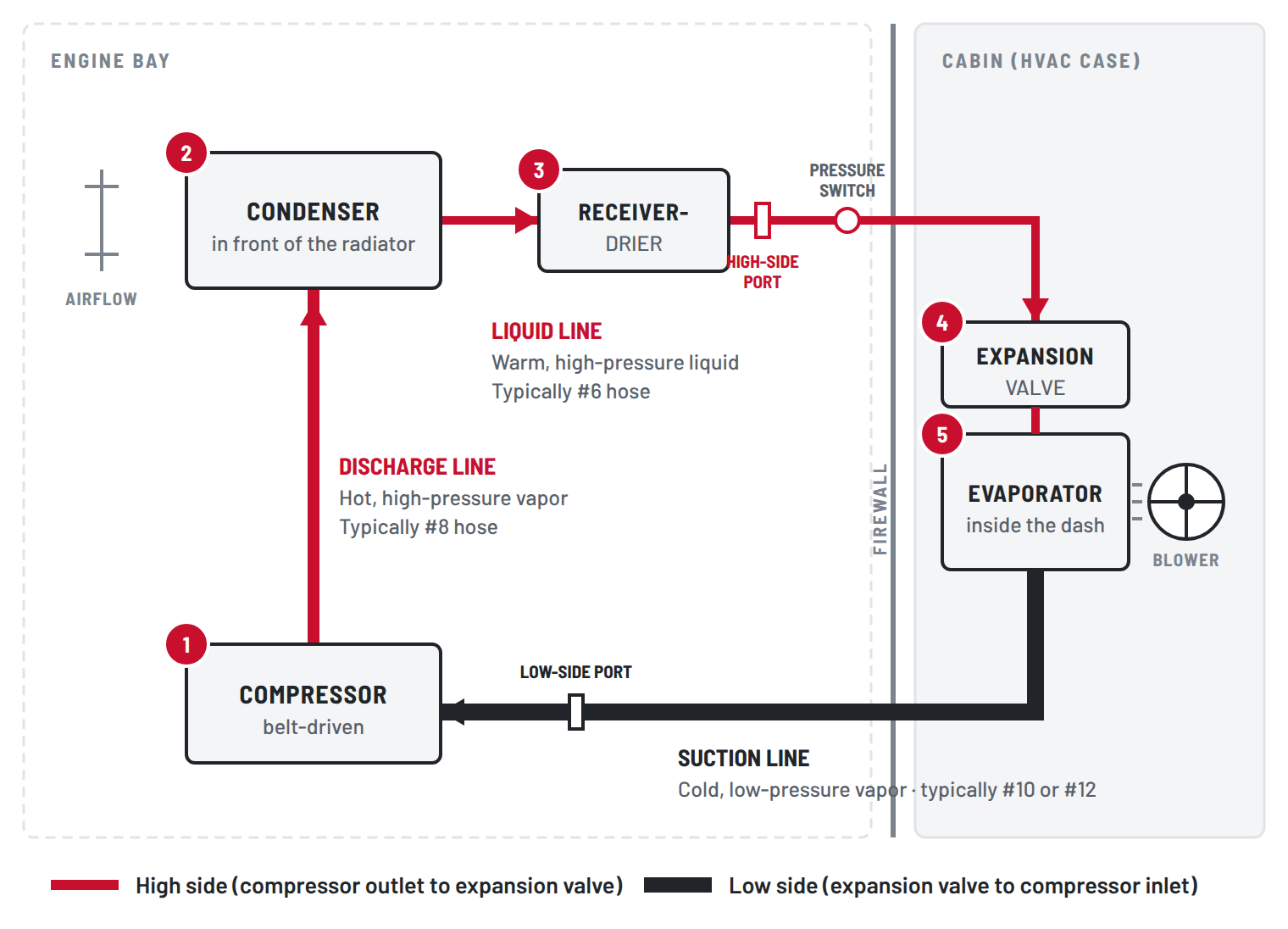
The compressor squeezes refrigerant vapor, which makes it hot and high-pressure. The condenser, in front of the radiator, lets outside air carry that heat away, and the vapor condenses into a warm liquid. The liquid passes through a receiver-drier that filters it and traps moisture, then reaches the expansion valve (or, on some vehicles, an orifice tube), which sprays it into the evaporator at low pressure. The sudden pressure drop makes the refrigerant boil, and boiling absorbs heat from the cabin air the blower is pushing through the evaporator. The now-cold vapor returns to the compressor and the cycle repeats. Hoses, lines, and fittings connect it all; switches and sensors keep it inside safe limits.
In this guide: The two sides · 1. Compressor · 2. Condenser · 3. Receiver-drier or accumulator · 4. Expansion valve or orifice tube · 5. Evaporator · Hoses, lines & fittings · Switches & controls · The air side · Refrigerant & oil · Symptom finder · FAQ
Two sides, one loop
Everything about A/C diagnosis starts with one fact: the loop has a high-pressure side and a low-pressure side, and two components mark the boundary between them.
The compressor raises pressure, so it is where the low side becomes the high side. The expansion valve drops pressure, so it is where the high side becomes the low side. Each side has a service port, and a manifold gauge set reads both at once. Almost every A/C symptom shows up as one of those two readings being higher or lower than it should be, which is why the rest of this guide keeps coming back to them.
Why pressure matters so much. A refrigerant boils at a temperature set by its pressure. Drop the pressure and it boils cold, absorbing heat. Raise the pressure and it condenses warm, giving heat up. The whole system is a way of making the same fluid do both, in two different places, at the same time.
Compressor
The compressor is the pump. Driven by the engine through a belt (or by a high-voltage electric motor on hybrids and EVs), it draws low-pressure vapor from the evaporator, compresses it, and sends it out as hot, high-pressure vapor. Compressing a gas heats it, which is the point: the vapor has to leave hotter than the outside air, or the condenser could not get rid of the heat.
Compressors are built to pump vapor. Liquid refrigerant does not compress, and if liquid reaches the compressor it can damage reed valves, pistons, or the scroll. Several other components exist partly to make sure that never happens.
Clutch vs. variable displacement
Older and simpler systems use a clutch on the compressor pulley. A switch or the control module engages it to run the compressor and releases it to stop, so the compressor cycles on and off. Most modern systems use a variable-displacement compressor that runs whenever the engine does and changes its own output through an internal control valve. When that valve fails, the compressor cannot build pressure, and the symptoms look a lot like a bad expansion valve. It is a far cheaper fix than a compressor.
What goes wrong
- Clutch failure: worn or burned clutch, a failed clutch coil, or an air gap that has grown with wear. The compressor never engages.
- Internal wear: the compressor runs but cannot build pressure. Low charge, lost oil, or a starved evaporator will wear one out early.
- Catastrophic failure: the compressor sheds metal into the system. Debris collects at the condenser, the drier, and the expansion valve or orifice tube. Replacing the compressor alone guarantees the new one fails too.
- Seal leaks: the shaft seal is a common leak point. A ring of oily dust around the pulley is the tell.
After a compressor failure, the repair is a system: compressor, drier, expansion valve or orifice tube, a flush of the lines and heat exchangers, and fresh oil. That is what our compressor replacement kits bundle together. Browse compressors, service valves, and idler and tensioner pulleys.
Condenser
The condenser sits in front of the radiator, and it looks like one. Hot, high-pressure vapor from the compressor enters at the top, outside air flows through the fins (pushed by road speed or pulled by the fans), and the refrigerant gives up enough heat to condense into a liquid by the time it reaches the bottom. Everything the system is trying to throw away leaves through the condenser.
Because it depends on airflow, the condenser is only as good as what is in front of it. Bugs, road debris, bent fins, or a fan that does not come on all push high-side pressure up and cooling down, especially at idle and in traffic.
What goes wrong
- Leaks from stone damage and corrosion. The condenser is the most exposed part of the system. Small punctures in aluminum can often be brazed rather than replaced; see our guide to patching aluminum A/C lines and condensers.
- Internal blockage. Modern condensers use very small passages. Debris from a failed compressor lodges in them, and a plugged condenser usually cannot be flushed clean; after a compressor failure it is normally replaced.
- Poor airflow. Dirty fins, a failed fan motor, or a fan clutch that will not lock up. High high-side pressure with poor cooling that improves at highway speed points here.
Browse condensers, universal condensers for custom builds, and condenser and radiator fan assemblies.
Receiver-drier or accumulator
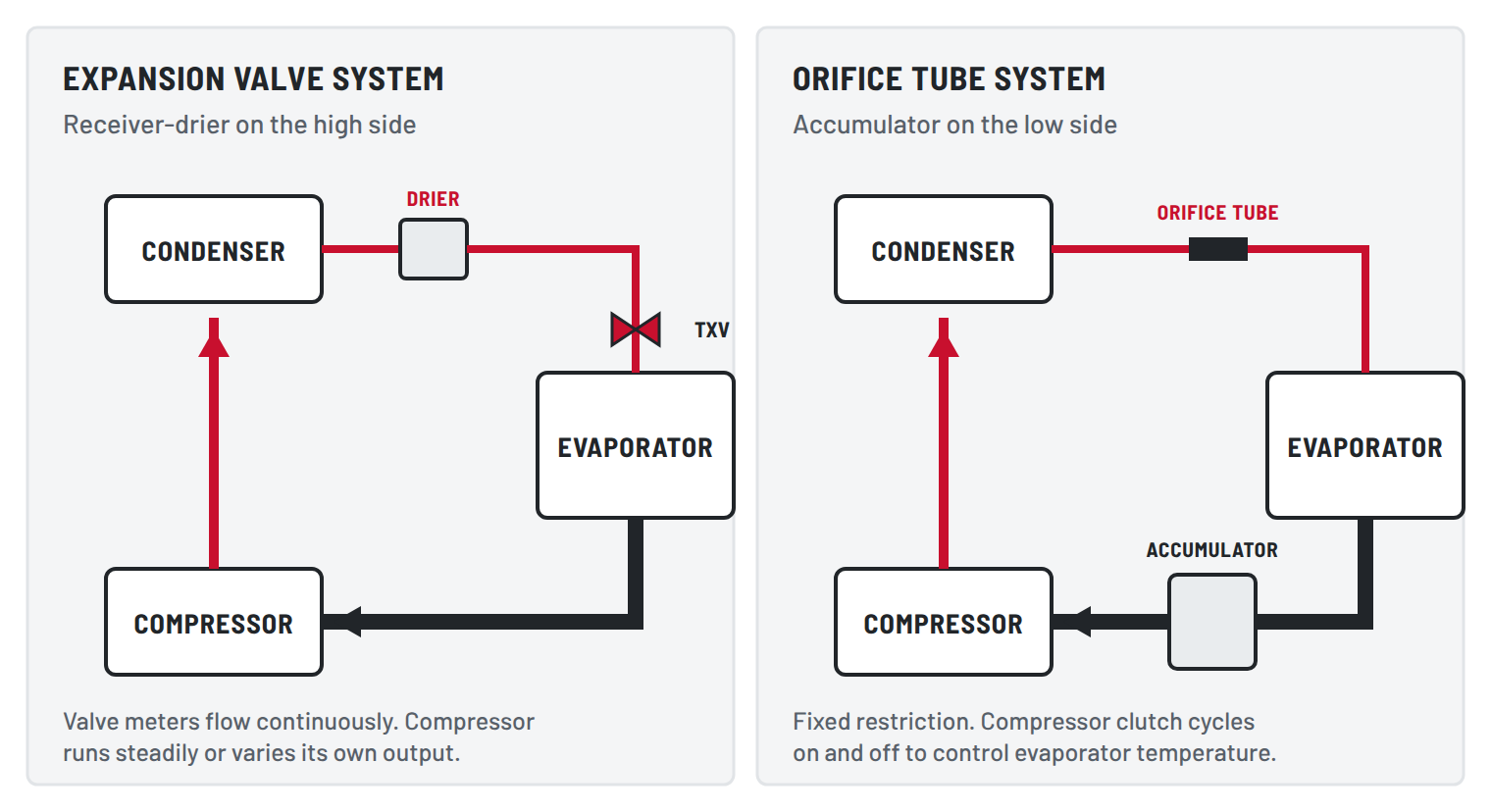
Every system has a canister with a bag of desiccant inside, and it does the most underrated job in the loop: it absorbs moisture. Water in an A/C system freezes at the expansion valve and blocks it, and combined with refrigerant and oil it forms acids that corrode the system from the inside. The desiccant can hold only so much, which is why the canister is replaced any time the system has been open to the air.
Which canister a vehicle has depends on which metering device it has. This is the fastest way to tell the two system types apart.
What goes wrong
- Saturated desiccant. The system was open too long, or has been leaking and drawing in humid air. Symptoms show up downstream as intermittent cooling (moisture freezing at the valve) and corrosion.
- Ruptured desiccant bag. Beads travel through the system and plug the valve or orifice tube screen.
- Plugged filter. A restriction at the drier looks like a restricted expansion valve on the gauges, but the frost or temperature drop is at the drier.
Browse receiver-driers and accumulators.
Expansion valve or orifice tube
This is the metering device, and it is where the high side becomes the low side. Warm liquid at high pressure goes in; a cold, low-pressure mist comes out. The pressure drop across this one small part is what makes the refrigerant boil in the evaporator, so it is the point where the cooling actually begins.
What goes wrong
An expansion valve can fail in two opposite directions, and the gauges tell them apart. Stuck closed or plugged, it starves the evaporator: the low side drops toward a vacuum, frost forms at the valve, and the vents blow warm. Stuck open, it floods the evaporator: the low side runs high, the suction line frosts back toward the compressor, and the vents are cool but never cold. An orifice tube can only plug, which looks like a valve stuck closed, and its screen is the best evidence you will get about the compressor’s health.
We cover the readings, the look-alikes, and the fix in Symptoms of a bad A/C expansion valve: stuck open vs. stuck closed. Browse expansion valves and orifice tubes.
Evaporator
The evaporator is a small radiator buried in the HVAC case under the dash. Cold refrigerant mist enters from the expansion valve and boils as it travels through the core, and boiling absorbs heat. The blower pushes cabin air through the fins, the air gives up its heat to the refrigerant, and what comes out the other side is cold. By the outlet, the refrigerant should be entirely vapor, slightly warmed, on its way back to the compressor.
The evaporator also dries the air. Its surface is cold enough that moisture in the air condenses on the fins and drains out through a tube under the car. That puddle under a parked car on a hot day is the evaporator working. It is also why the A/C runs in defrost mode: dry air clears a fogged windshield faster.
What goes wrong
- Leaks. Evaporators corrode from the outside in, helped along by the damp, and a leaking evaporator usually means dash removal to replace it. UV dye at the drain tube or a detector probe at the vents finds it.
- Freezing over. If the evaporator runs too cold (low charge, a flooding valve, a failed temperature sensor, or a compressor that will not cycle off), condensation freezes on the fins, blocks the airflow, and the vents go weak and warm until it thaws.
- Blocked drain. Water backs up into the case, sloshes on turns, and eventually into the passenger footwell. Musty smell is the early warning.
- Debris on the fins. Leaves and dirt that got past a missing or torn cabin filter cut airflow.
Browse evaporator cores and assemblies.
Hoses, lines, and fittings
The five components above are connected by a mix of rigid aluminum lines and flexible rubber hose. Hose goes where things move: between the compressor, which rocks with the engine, and the condenser and firewall, which do not. Each run has a name that tells you what is inside it.
| Line | Runs from → to | What is inside | Typical Size |
|---|---|---|---|
| Discharge line | Compressor → condenser | Hot, high-pressure vapor. The hottest line in the system. | #8 |
| Liquid line | Condenser → drier → expansion valve | Warm, high-pressure liquid | #6 |
| Suction line | Evaporator → compressor | Cold, low-pressure vapor. The line that sweats. | #10 or #12 |
Sizes are the common pattern, not a rule. Match what came off the vehicle or the ports on the components.
A/C hose is not ordinary rubber hose. Refrigerant molecules are small enough to seep through plain rubber, so A/C hose has a nylon barrier layer in its wall. Hose ends are crimped on with beadlock fittings, and the fittings seal to components with O-rings (the standard on R-134a and R-1234yf vehicles), flares (common on older R-12-era systems), or spring-lock couplings. Every one of those joints is a potential leak, and O-rings are replaced any time a joint is opened.
Because hose can be cut to length and fittings come in every angle, a hose that is no longer available for a vehicle can be built. Our guide How to build a custom A/C hose: measure, cut, crimp, check walks through it, and our hose repair and manufacturing service can build or repair it for you. Browse A/C hose, fittings, and O-rings, gaskets, and seals.
Service ports and valve cores
Each side of the system has a service port with a Schrader-type valve core inside it and a cap over it. The ports are where gauges, recovery machines, and charging equipment connect. R-134a and R-1234yf ports are different sizes, so the wrong equipment cannot be connected by mistake. Valve cores leak with age and are cheap to replace; the cap is the primary seal, so a missing cap is a leak waiting to happen.
Switches, sensors, and relays
The refrigerant loop cannot look after itself. A handful of electrical parts keep it inside safe limits and decide when the compressor runs.
Pressure switches
A low-pressure switch keeps the compressor off when the charge is too low to carry oil. A high-pressure switch shuts it off before pressure gets dangerous. A binary switch does both; a trinary switch adds a mid-pressure contact that turns the condenser fan on. Newer vehicles use a pressure transducer that reports the actual pressure to the control module.
Shop switches →Temperature control
An evaporator temperature sensor or thermostat cycles the compressor (or trims a variable compressor) so the evaporator stays just above freezing. When it fails, the evaporator ices over or never gets cold.
Shop switches & sensors →Relays & connectors
The compressor clutch and the blower draw real current, so they run through relays. A failed clutch relay is a common reason for “A/C does nothing,” and corroded or melted connectors are a common reason for “A/C works when it feels like it.”
Shop relays →Pressure relief valve
A mechanical valve on the compressor or high side that vents refrigerant if pressure climbs past what the switches should have prevented. If it has opened, something else failed first.
Read about relief valves →Control module
On most vehicles built in the last two decades, the HVAC or engine control module decides when the compressor runs, using the pressure transducer, evaporator sensor, engine load, and cabin requests. A scan tool that reads live A/C data shortens diagnosis considerably.
Shop electrical →Control valve
Inside a variable-displacement compressor, the control valve sets how much the compressor pumps. Failed, it mimics a bad expansion valve or a worn compressor on the gauges.
Shop control valves →The air side: what happens in the HVAC case
Refrigerant does the cooling, but air is what the driver feels. The HVAC case under the dash routes cabin air past the evaporator and the heater core and out the vents, and several “A/C” complaints are air-side problems that have nothing to do with refrigerant.
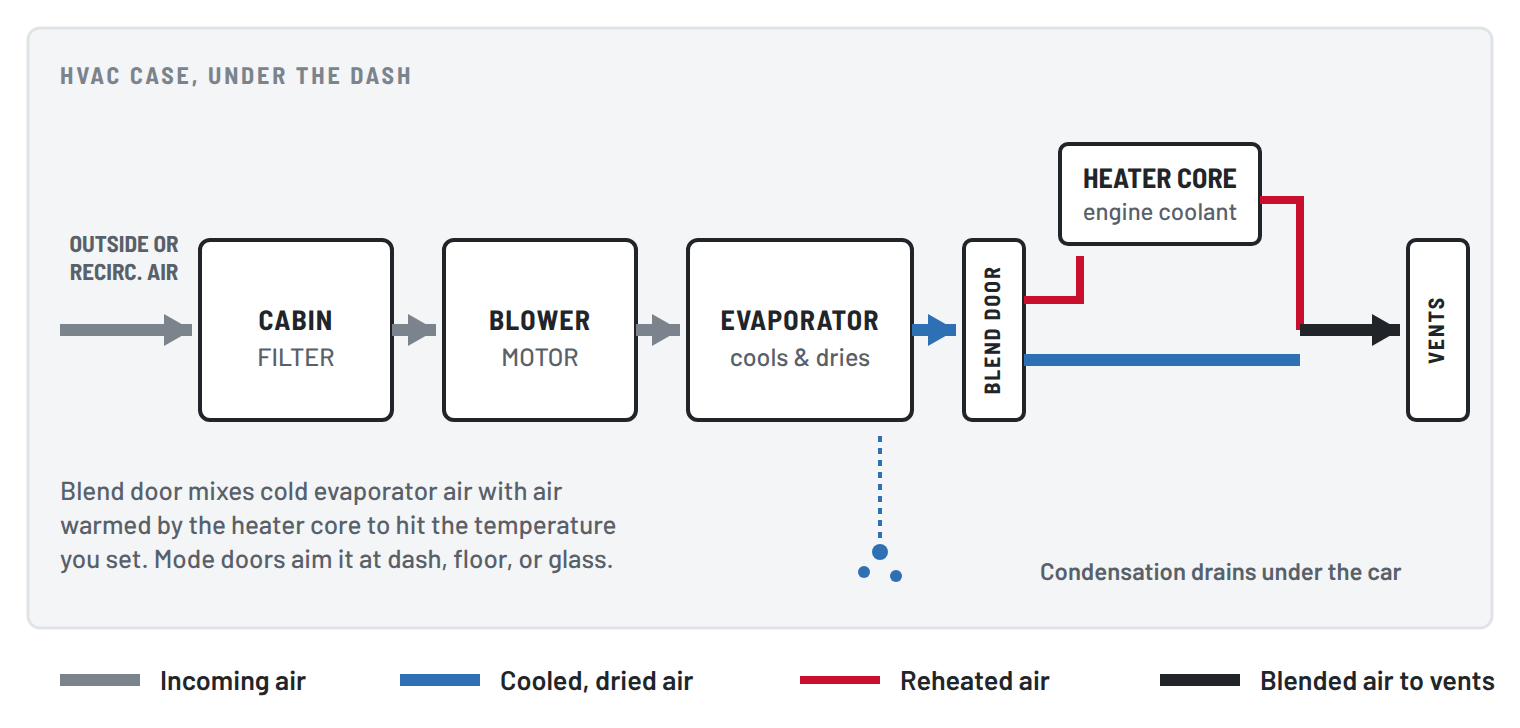
- Cabin air filter. Catches dust and leaves before the blower. A plugged one cuts airflow at every setting and is the first thing to check for weak vents. Browse cabin air filters.
- Blower motor. Moves the air. Failed motors, worn brushes, a bad resistor or control module (one or more fan speeds missing), and debris in the squirrel cage are the usual faults. Browse blower motors, housings, and wheels.
- Blend door and heater core. The blend door mixes cold evaporator air with air warmed by the heater core. A blend door stuck toward heat makes a perfectly good A/C system blow warm, and a heater core that cannot be shut off does the same. Warm air with normal gauge readings points here.
- Mode doors. Aim the air at the dash, floor, or windshield. A failed door actuator is a clicking noise and air in the wrong place.
- Recirculation. Recirculating already-cooled cabin air lets the evaporator get ahead on a hot day. Fresh-air mode is for defogging and for keeping the cabin from going stale.
Refrigerant and oil
The refrigerant is the working fluid. Three have been used in cars, and they are not interchangeable.
The refrigerant also carries the compressor’s oil around the loop. There is no oil sump; a measured quantity of oil circulates with the refrigerant and returns to the compressor. That is why a low charge or a starved evaporator hurts the compressor, why oil is added back when a component is replaced, and why the oil type has to match the refrigerant and the compressor. Browse A/C lubricants.
Refrigerant is recovered, never vented. It is illegal in the U.S. to knowingly release refrigerant, and servicing it requires certified equipment and, for shops, Section 609 certification. Charge is set by weight to the vehicle’s specification, not by feel or by gauge alone. Shops can start with our Section 609 training page; see recovery machines, vacuum pumps, and gauges and charging hoses.
Symptom finder: which component is talking?
A starting point, not a diagnosis. Confirm the charge is correct before you trust any gauge reading, and see the linked guides for the full procedure.
| What you see | Look first at | Then |
|---|---|---|
| A/C does nothing; compressor never engages | Charge, low-pressure switch, clutch relay, clutch coil, fuse | Control module data if the electrical basics check out |
| Both gauges low, poor cooling | Low charge (a leak) | Dye or detector; O-rings, hose crimps, condenser, shaft seal, evaporator |
| Low side low or in vacuum, high side low to normal, frost at one spot | Restriction: expansion valve, orifice tube, or drier | Frost or temperature drop marks the spot. Expansion valve guide |
| Low side high, suction line frosted, vents cool not cold | Expansion valve stuck open or bulb problem | Bulb mounting on capillary valves |
| Low side high, high side low | Compressor or its control valve | Control valve before condemning the compressor |
| Both gauges high, worse in traffic | Condenser airflow, fans, overcharge | Air in the system if fans and charge are right |
| Cold, then warm, then cold again | Moisture freezing at the valve; evaporator icing | New drier, long evacuation; evaporator temperature sensor |
| Warm air, gauges normal | Blend door, heater core flow, mode doors | Air side, not refrigerant |
| Weak airflow at all speeds | Cabin filter, evaporator icing or debris, blower | Check the filter before anything else |
| Water in the footwell, musty smell | Evaporator drain | Clear the drain tube |
Car A/C basics FAQ
How does a car air conditioner work?
What are the main components of a car A/C system?
What is the difference between the high side and the low side?
What does the receiver-drier or accumulator do?
What is the difference between an expansion valve and an orifice tube?
Why does water drip under my car when the A/C is on?
Does a car A/C system use oil?
What is the difference between R-134a and R-1234yf?
Why does my A/C only work when the car is moving?
Can I just add refrigerant if my A/C is weak?
How often should a car A/C system be serviced?
Everything in the loop, in stock
Compressors, condensers, driers, expansion valves, evaporators, hose, fittings, switches, and the tools to service them, shipped from Mesa, Arizona. Not sure which part you need? Call with the vehicle or the part in your hand.
Shop all A/C partsCustom hose helpThis guide is general technical information for qualified technicians and experienced DIYers. Always follow the vehicle manufacturer’s service information and applicable refrigerant-handling regulations. Refrigerant must be recovered, not vented.