

Every A/C fitting listing carries a small set of numbers: a Size like #6 or #10, a Beadlock Tube Size, a Thread, and a Hose size. They do not all match, and confusing them is how the wrong part ends up in the box. This page puts all four on one chart, shows what each one is measured across, and explains how to read them off a fitting in your hand. The chart is drawn from beadlock fittings, the crimp-on style used for nearly every hose we build; barbed push-on fittings share the Size numbers but use a different stem. Every number here comes from our own product listings.
A/C fitting sizes: #6, #8, #10, and #12
The Beadlock Tube Size is the one to work from when you are building a hose: it is the tube on a beadlock fitting that slides inside the hose, and it is the same number as the hose bore. The Tube Size column is what our listings quote for the other end: the size of the hard line or component port the O-ring end connects to. It is a connection size, not a diameter of the fitting itself. Thread diameters are for O-ring style fittings, the standard on R-134a and R-1234yf vehicles.
| Size | Beadlock Tube Size (= hose bore) | Thread (O-ring style) | Tube Size (line the O-ring end connects to) | Standard O-ring | Typical job |
|---|---|---|---|---|---|
| #6 | 5/16″ | 5/8″ | 3/8″ | 233-3024 | Liquid line |
| #8 | 13/32″ | 3/4″-16 | 1/2″ | 233-3047 | Discharge line |
| #10 | 1/2″ | 7/8″-14 | 5/8″ | 233-3088 | Suction line |
| #12 | 5/8″ | 1-1/16″ | 3/4″ | 233-3103 | Suction line, larger systems |
The two size columns describe opposite ends of the same fitting, which is why they never match: one is the tube that goes into the hose, the other is the line the O-ring end bolts to. In the trade a hose is usually named after the tube it fits, so #6 hose is often called “3/8 hose” even though its bore, and the beadlock tube that goes into it, are 5/16″. Thread pitch (the -16 and -14) is shown where our product pages list it. “Typical job” is the common pattern, not a rule: match the hose that came off the vehicle or the port on the component. Sources: our beadlock fitting pages for #6 (235-1502), #8 (235-1503), #10 (235-1504) and #12 (235-1505), our bulk hose listings, and our O-ring listings.
In this guide: What each number measures · The sizes to scale · Where each size is used · Measuring a fitting · Mixed sizes and adapters · O-rings by size · Metric threads · What we stock by size · FAQ
What each number is measured across
Our fitting listings use five labels. Four are dimensions and one is a shape. Here they are on a single beadlock hose fitting, the most common style we sell. Note that a hose fitting has two ends and they connect to different things: an O-ring end that seals to a component, and a hose end whose tube slides inside the hose. On a beadlock fitting that tube is one diameter the whole way.
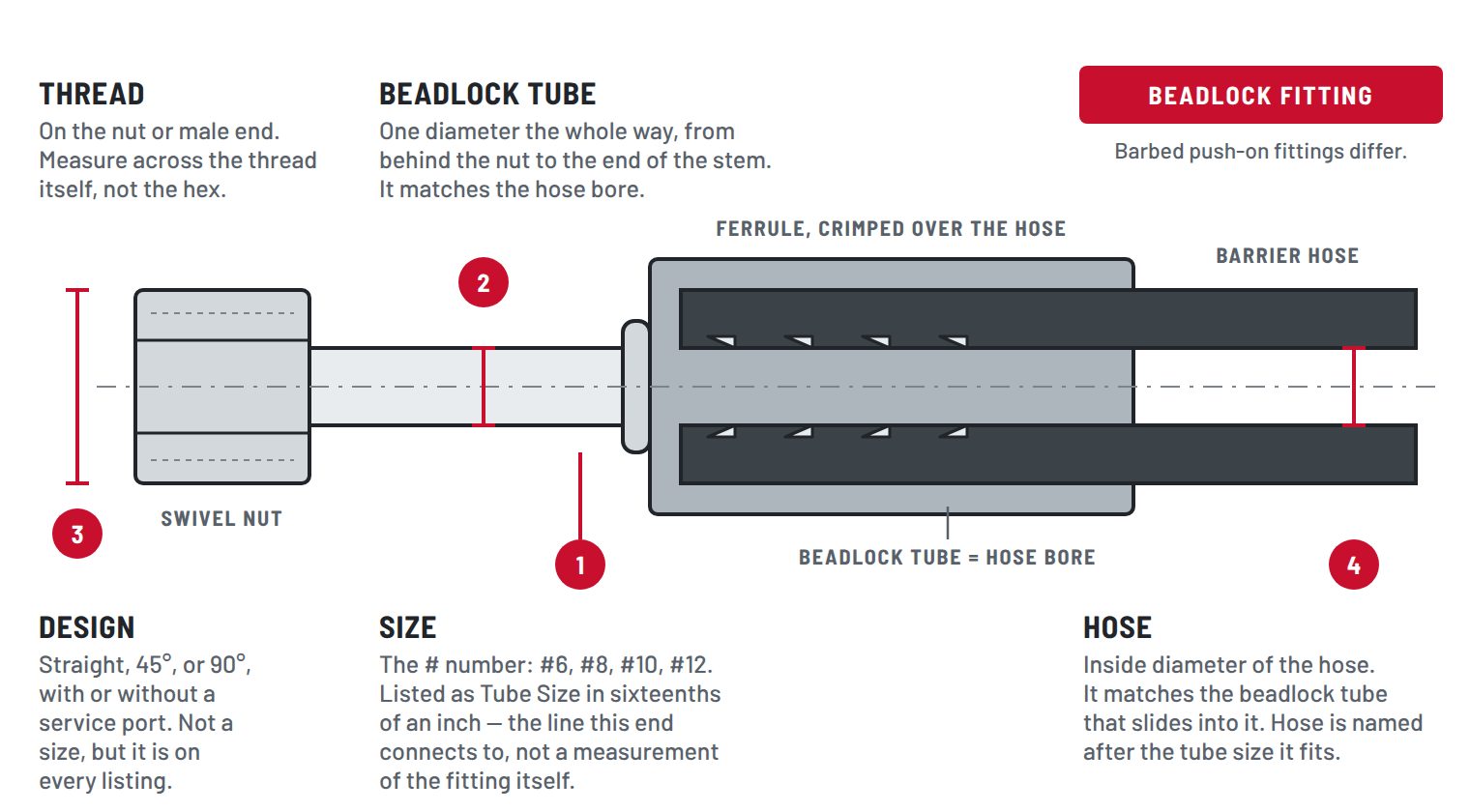
Why one fitting carries three different numbers. Two of them are measurements of the part and one is not. The beadlock tube and the hose bore are the same size, because one slides inside the other. The thread is larger, because it wraps around that tube. The listed Tube Size is not a diameter of the fitting at all — it is the line the O-ring end bolts to. A #10 fitting has a 1/2″ beadlock tube and hose bore and a 7/8″ thread, and it connects to a 5/8″ line.
Beadlock or barbed? Every dimension on this page is a beadlock fitting, the crimp-on style used for nearly every hose we build. Barbed (push-on) fittings carry the same Size, Thread and Hose numbers and go on the same hose, but the stem is a different animal: ribbed, and larger across the barbs, because the hose has to grip it under a clamp instead of being crimped. So a caliper reading taken off a barb will not match the beadlock tube column above. Match barbed fittings by the Size number.
The four sizes to scale
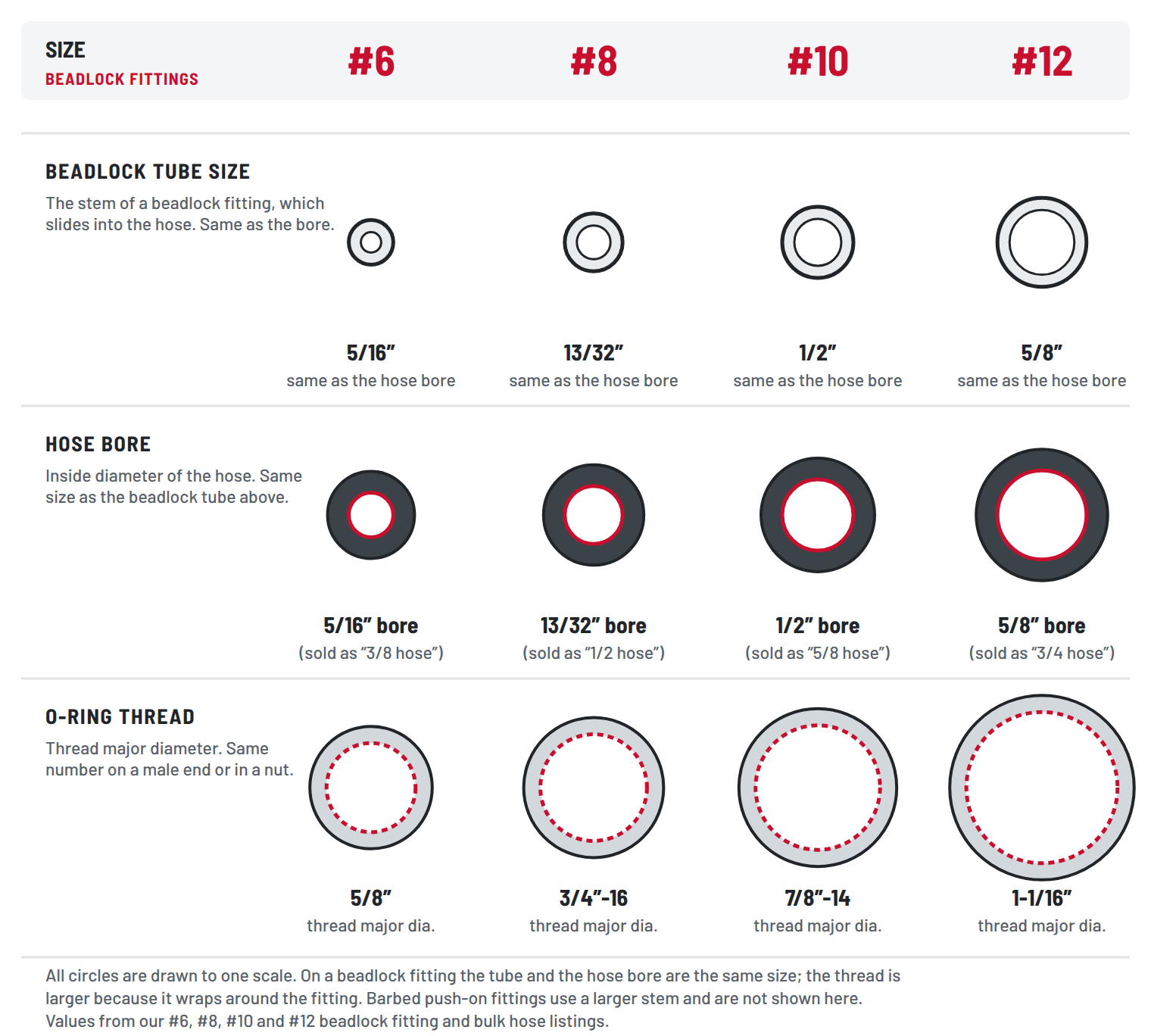
Where the # number comes from: it is the size of the line the O-ring end connects to, in sixteenths of an inch. #6 is 6/16 (3/8″), #8 is 8/16 (1/2″), #10 is 10/16 (5/8″), #12 is 12/16 (3/4″). The beadlock tube, the hose bore, and the thread all hang off that number without matching it.
Where each size is used on the vehicle
Line size follows what is inside the line. Liquid takes less room than vapor, so the liquid line is the smallest hose on the car and the suction line the largest. That gives a pattern that holds on most vehicles.
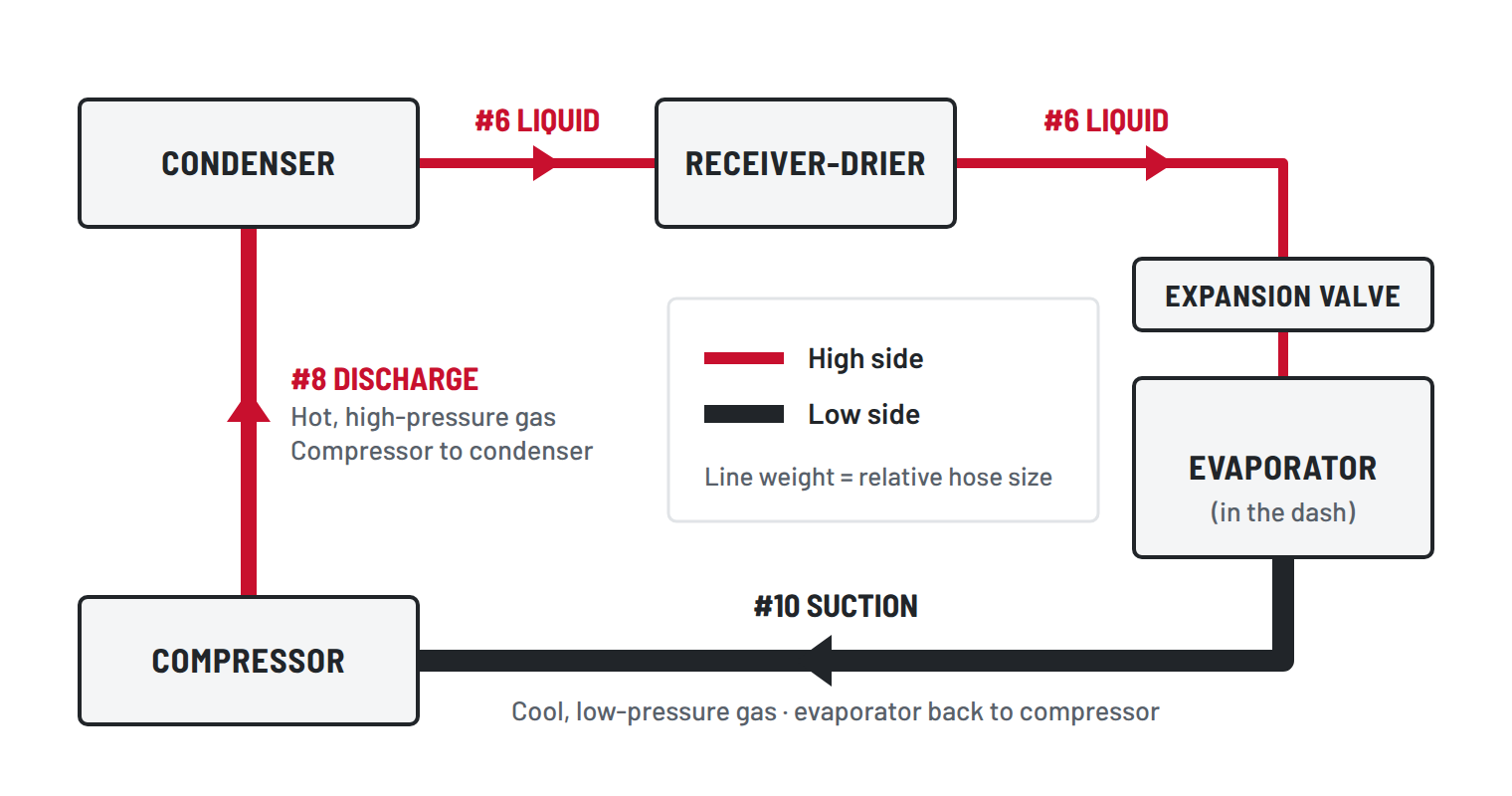
- #6: liquid line, condenser to receiver-drier and drier to expansion valve. Warm, high-pressure liquid.
- #8: discharge line, compressor to condenser. Hot, high-pressure vapor.
- #10: suction line, evaporator back to the compressor. Cold, low-pressure vapor.
- #12: suction line on larger systems, and on some trucks, vans, and rear-air setups.
For how the loop works and what each component does, see How a car A/C system works, component by component.
How to tell which Size you have
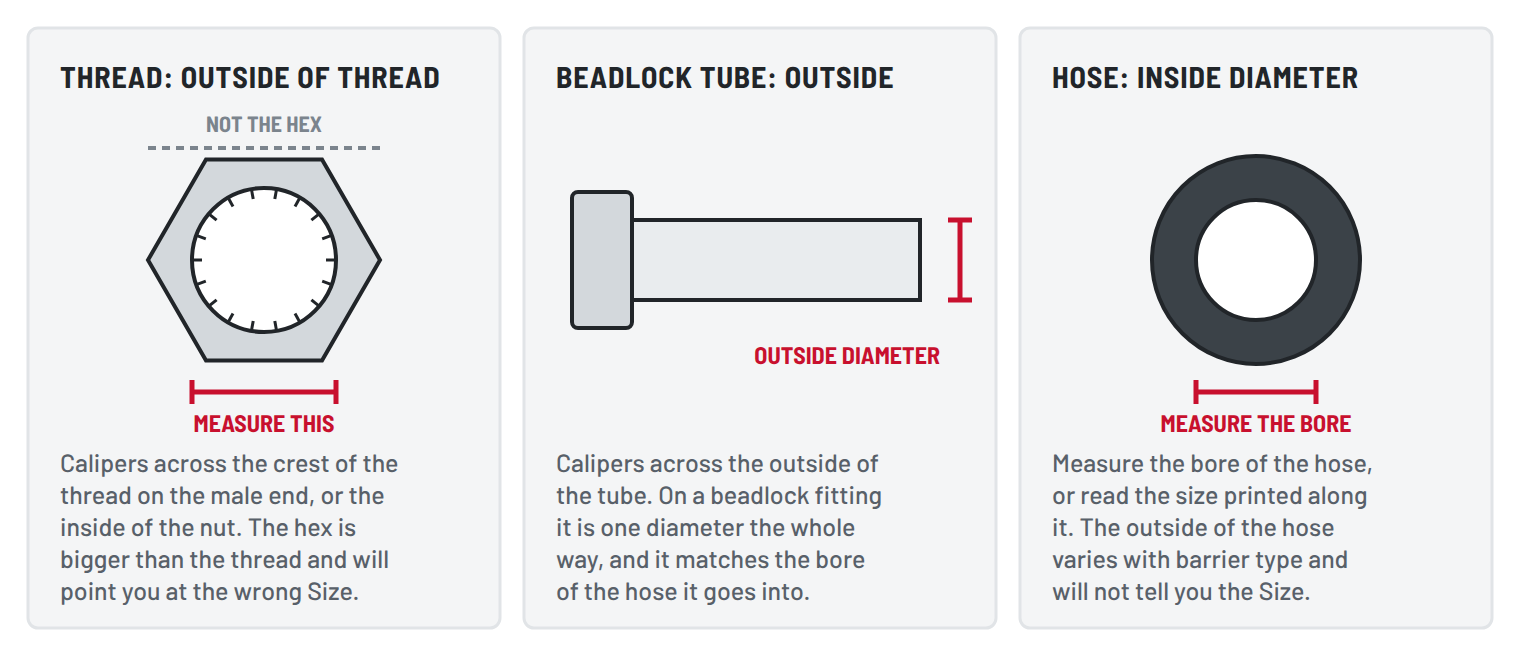
If the fitting is not marked, a few measurements with a caliper will identify it. Take whichever is easiest to reach and check it against the chart, remembering that the hose end and the O-ring end of the same fitting connect to different things.
| If you measure… | #6 | #8 | #10 | #12 |
|---|---|---|---|---|
| Across the O-ring thread | 5/8″ | 3/4″ | 7/8″ | 1-1/16″ |
| Across the beadlock tube (hose end) | 5/16″ | 13/32″ | 1/2″ | 5/8″ |
| Line the O-ring end connects to (listed, not measured on the fitting) | 3/8″ | 1/2″ | 5/8″ | 3/4″ |
| Inside the hose bore (actual) | 5/16″ | 13/32″ | 1/2″ | 5/8″ |
| Hose as it is usually named | “3/8 hose” | “1/2 hose” | “5/8 hose” | “3/4 hose” |
| O-ring ID (standard hose-fitting O-ring) | 0.295″ | 0.413″ | 0.515″ | 0.699″ |
Three mistakes that produce the wrong Size
- Measuring the wrong end. The hose end and the O-ring end of the same fitting connect to different things. Check which end you are holding against the chart.
- Measuring the hex. The nut’s across-flats dimension is bigger than the thread. Measure the thread crest on the male end, or the inside of the nut.
- Measuring the outside of the hose. Standard barrier and reduced barrier hose of the same Size have different outside diameters. Only the bore tells you the Size, and the size is usually printed along the hose anyway.
- Reading a mixed-size fitting from the wrong end. Some fittings join one Size of port to another Size of hose. Check both ends; see the next section.
Reading a thread by feel is not reliable. If the fitting is metric, or if a caliper reading lands between two sizes, call us at 480-507-2229 with what you measured and we will sort it out before you order.
Mixed sizes, step-ups, and adapters
Most hose fittings are the same Size at both ends: a #8 O-ring nut on a #8 hose end. Some are not, and the listing says so. Read the name as port end × hose end.
#6 O-ring × #6 hose
The ordinary case. Straight, 45°, and 90° versions in every Size.
See 235-1502 →#10 O-ring × #12 hose
A #10 port with a larger #12 hose behind it, for suction lines that step up to reduce restriction.
See 235-1506 →#8 male insert × #10 hose
A male insert O-ring end (the fitting carries the O-ring) with a #10 hose end behind it.
See 235-743 →Adapters change one Size or one seal type to another without a hose in between: #10 male insert O-ring to #8 female flare, for example. They are the answer when a component port and the hose you have do not agree, and the wrong answer when what you actually need is the right fitting. Browse adapters.
Flare fittings use the same Size numbers but seal metal-to-metal on a cone instead of on an O-ring, so a #8 flare and a #8 O-ring fitting will not connect to each other even though both are “#8.” Flare is common on R-12-era vehicles and some aftermarket components. The thread column in the chart above is for O-ring style; flare threads are listed on the individual product pages. Browse flare fittings.
O-rings by Size
O-ring fittings seal on an O-ring that sits on the tube, so O-rings follow the Size number too. These are our standard hose-fitting O-rings, with the dimensions from each listing. Every joint you open gets a new one, lightly coated with the system’s refrigerant oil.
| Size | Part | ID | OD | Pack |
|---|---|---|---|---|
| #6 | 233-3024 | 0.295″ (7.65 mm) | 0.441″ (11.21 mm) | 10 |
| #8 | 233-3047 | 0.413″ (10.82 mm) | 0.566″ (14.38 mm) | 10 |
| #10 | 233-3088 | 0.515″ (14 mm) | 0.669″ (17 mm) | 10 |
| #12 | 233-3103 | 0.699″ (17.17 mm) | 0.816″ (20.73 mm) | 10 |
These are the standard sizes. Many vehicles use captive, GM, Ford, or metric O-rings with different dimensions for the same Size number, and R-1234yf systems have their own seals, so match the O-ring to the fitting and the vehicle, not just to the Size. Browse all A/C O-rings and R-1234yf O-rings and seals.
Metric threads and the Size they pair with
Many import vehicles use metric threads on their A/C ports. The hose behind the fitting is still sized in the # system, so a metric fitting is listed as a metric female O-ring thread on one end and a # hose on the other. These are the pairings in our metric fitting range.
| Hose Size | Metric female O-ring threads we stock for it |
|---|---|
| #6 | 14 mm · 16 mm · 18 mm · 20 mm |
| #8 | 20 mm |
| #10 | 22 mm · 24 mm · 27 mm |
| #12 | 27 mm |
A metric thread will not start on an SAE port, and a caliper reading that lands between two chart sizes (a 16 mm thread reads 0.63″, right next to 5/8″) is the usual sign you are looking at one. Identify the thread before ordering. Browse metric fittings.
What we stock in each Size
A count of listings by fitting family and Size, from our catalog. Use it to find the family you need, then filter by Size on the category page.
| Family | #6 | #8 | #10 | #12 | |
|---|---|---|---|---|---|
| O-ring fittings | 51 | 55 | 66 | 39 | Browse |
| Barbed fittings | 15 | 17 | 22 | 16 | Browse |
| Weld-on fittings | 10 | 12 | 15 | 15 | Browse |
| Splicers | 11 | 14 | 16 | 13 | Browse |
| Steel fittings | 12 | 14 | 18 | 12 | Browse |
| With service ports | 10 | 15 | 13 | 1 | Browse |
| Flare | 11 | 13 | 11 | 8 | Browse |
| Springlock | 8 | 7 | 7 | 7 | Browse |
| Metric | 14 | 5 | 6 | 3 | Browse |
| Bulkhead | 14 | 4 | 16 | 0 | Browse |
| Reduced barrier | 3 | 3 | 4 | 5 | Browse |
| Adapters | 3 | 4 | 4 | 1 | Browse |
Counts are listings whose name carries that Size, taken in September 2026. Some fittings carry two Sizes and are counted under both. Stock changes; the category pages are current.
Hose in every Size, by the foot and in 25 ft and 50 ft rolls: A/C hose. Building the hose yourself? Start with How to build a custom A/C hose, or have us build it through hose repair and manufacturing.
A/C fitting size FAQ
What do #6, #8, #10 and #12 mean on A/C fittings?
What size is a #6 A/C fitting?
What size is a #8 A/C fitting?
What size is a #10 A/C fitting?
What size is a #12 A/C fitting?
Is #6 hose 3/8 inch or 5/16 inch?
Why does one fitting have three different sizes on it?
How do I measure an A/C fitting to find its size?
Can I measure the outside of the hose to find the size?
Are #6, #8, #10 and #12 the same as dash sizes or AN sizes?
Will a #8 flare fitting connect to a #8 O-ring fitting?
What size O-ring does a #10 fitting take?
Which size hose goes on the liquid line, discharge line, and suction line?
My thread measures 16 mm. What size is that?
Do R-1234yf systems use the same fitting sizes?
Fittings in every Size, straight, 45°, and 90°
O-ring, barbed, flare, splicer, bulkhead, weld-on, and metric fittings in #6 through #12, with the hose and O-rings to match. Not sure what you measured? Call with the numbers and we will match the part before you order.
Shop all fittingsO-ring fittingsDimensions on this page are taken from Air Components product listings and are for identification. Confirm the port, seal type, and hose against your application before ordering or crimping.