

Most R-1234yf recovery, recycling and charging machines warn you before they quit. The oxygen sensor inside the refrigerant identifier is a consumable, and when it nears the end of its life the machine says so — before it locks out. The shop that reads that message orders a sensor and keeps working. The shop that ignores it finds out the hard way, mid-job, with a car on the lift.
In this guide: How long the sensor actually lasts · The three stages · What the warning looks like · Why sensors wear out early · Confirming which sensor fits · What to order · FAQ
How long does the sensor last?
Roughly two years from activation, though actual life varies with how much the machine is used and how it is stored between jobs. It is an electrochemical oxygen sensor — a wearing part with a real, finite service life, not something that fails only from misuse. Every recovery machine that identifies R-1234yf before it recovers or charges — Robinair, Mahle/RTI, Mastercool and CPS units among them — relies on the same kind of Neutronics-based sensor element to do it, so this applies across brands, not just one.
Two years is a planning number, not a warranty. A machine run hard, every day, in a hot shop will likely see the low end of that range. A backup machine that mostly sits will likely see more. Go by the machine's own warning, covered next, rather than counting months on a calendar.
Three stages: in service, warning, locked out
This is the part worth knowing before it happens to you. The sensor does not simply die one day without notice. It moves through a stage built for exactly this — a window where the machine is telling you to order the part, while it still works well enough to keep using.
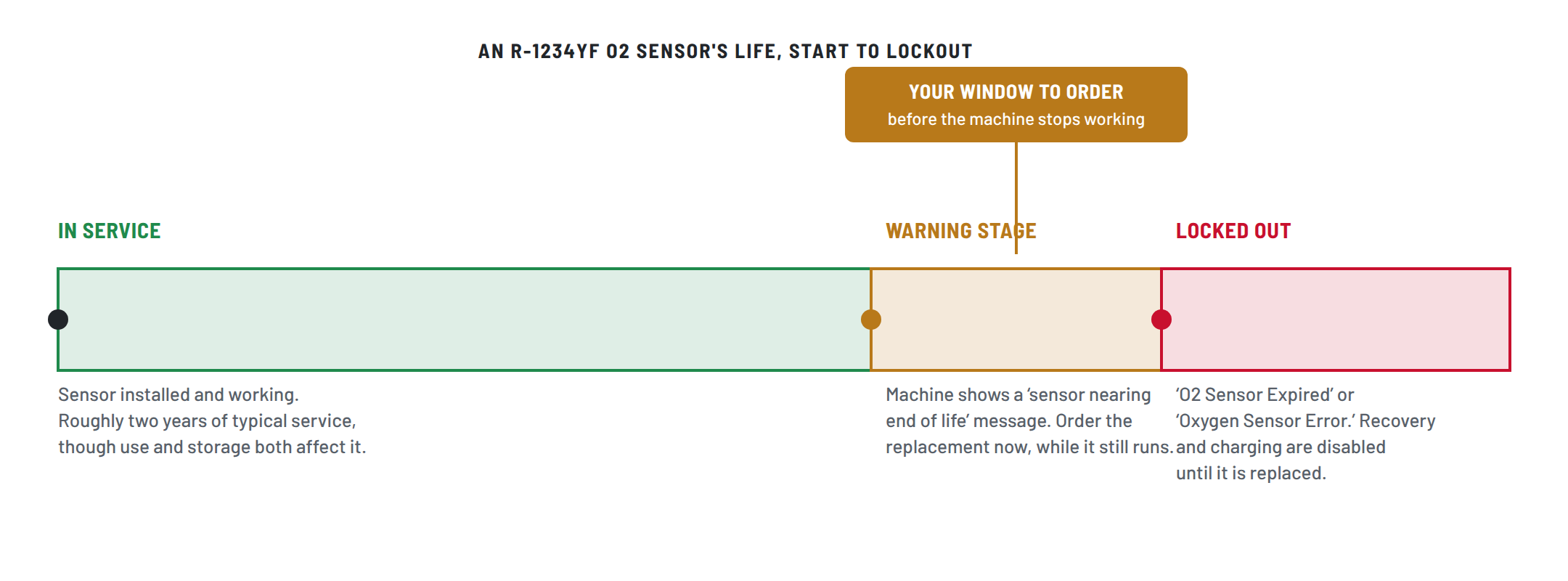
In service
The sensor works normally and the machine identifies refrigerant purity as designed. Nothing to do here except know roughly where you are in the sensor's life.
Warning stage
The machine displays an advance notice — wording varies by brand and model, but the meaning is the same: the sensor is nearing the end of its life. The machine still runs. This is the order-it-now moment.
Locked out
The sensor has expired. The machine shows a fault such as “O2 Sensor Expired” or “Oxygen Sensor Error” and disables recovery and charging until a fresh sensor is installed. This is what a missed warning turns into.
What the warning looks like on the machine
The exact wording differs by brand and model, and we are not going to guess at a specific screen we have not confirmed on your unit. What is consistent across Neutronics-based identifiers is the pattern: a message referencing the oxygen sensor or the identifier nearing the end of its service life, distinct from the harder fault that follows once it actually expires. If your display shows anything mentioning the O2 sensor, the oxygen sensor, or the identifier — whether or not the machine has stopped working yet — treat it as the warning stage and order the replacement.
Not sure what your specific model displays? Call 480-507-2229 with your machine model and, if you can read it, the exact message on the screen. We will confirm whether it is the warning stage or the full lockout, and get you the right sensor either way.
Why sensors wear out, and why some go early
An electrochemical oxygen sensor works by consuming itself slowly, at the molecular level, every time it measures. That is the mechanism, not a defect, and it is why the part has a life span at all rather than lasting indefinitely. Two things move that life span around:
How often the machine runs
A sensor that samples refrigerant on every recovery cycle, all day, ages faster than one in a machine that runs occasionally.
How the machine sits between jobs
Temperature and how the unit is stored when idle both affect an electrochemical cell. A machine in a hot, uninsulated bay works its sensor harder even sitting still.
It is still a wear part
Even under ideal conditions, the sensor consumes itself by design. There is no maintenance step that extends its life indefinitely — only the warning stage that tells you when to order.
Confirm which sensor fits your machine
Most shops running an R-1234yf identifier need one of two families, and they are not interchangeable. Getting this step right the first time avoids a return.
Neutronics / Bacharach-based identifiers
Used inside Robinair, Mahle/RTI, Mastercool and CPS machines. All of these share the same base sensor element, so one replacement part covers all four brands.
IDX-based identifiers
A different identifier design that does not use the Neutronics element and is not compatible with it. Check your machine's identifier type before ordering — the two are not interchangeable.
If you are not sure which your machine uses, send us the model number and we will confirm before you order.
Order ahead, not mid-job
A spare sensor on the shelf turns a lockout from a stopped bay into a five-minute swap. We stock the Neutronics-based replacement that fits the Robinair AC1234-4, -4SL, -4-230, -6 and -9, the 16990 and 16995 standalone identifiers, Mahle/RTI ArcticPRO ACX2280, ACX2250, ACX11280 and the ACX22XX/ACX12XX series, Mastercool Commander 4000 and 4100, and CPS FX3030 and FX-Series units with the integrated EID analyzer.
While the machine is open for the sensor, it is also a good moment to look at the identifier's small inline filter and replace it if it looks dark or yellow, per the sensor's own installation notes. That filter is separate from the machine's main refrigerant filter-drier.
R-1234yf O2 sensor FAQ
How long does an R-1234yf oxygen sensor actually last?
What does the warning look like before the sensor fully fails?
What happens once the sensor fully expires?
Can I keep using the machine once I see the warning?
Does the same sensor fit Robinair, Mahle, Mastercool and CPS machines?
Why do some shops see sensors fail sooner than two years?
Should I keep a spare sensor on the shelf?
Is there anything else worth replacing at the same time?
Keep your recovery machine running
R-1234yf O2 sensors, identifier filters and recovery machine parts for Robinair, Mahle/RTI, Mastercool and CPS units. Not sure which sensor your machine needs? Call with the model number and we will confirm before you order.
Related reading: The hidden ROI of automatic recovery machines · The financial case for 98.5% recovery efficiency · How a car A/C system works, component by component