

Beadlock and barbed fittings both connect a fitting to a length of A/C hose, and they are not interchangeable. Put the wrong one on the wrong hose — or the right one on the right hose but crimped or clamped wrong — and you get a comeback: a slow leak that shows up weeks later, not a failure on the bench. Here is what actually separates the two, when each one is the right call, and the mismatches that cause the leaks.
In this guide: What's actually different · Why mismatches cause leaks · Which one for which job · Matching fitting to hose · What we stock · FAQ
What's actually different between them
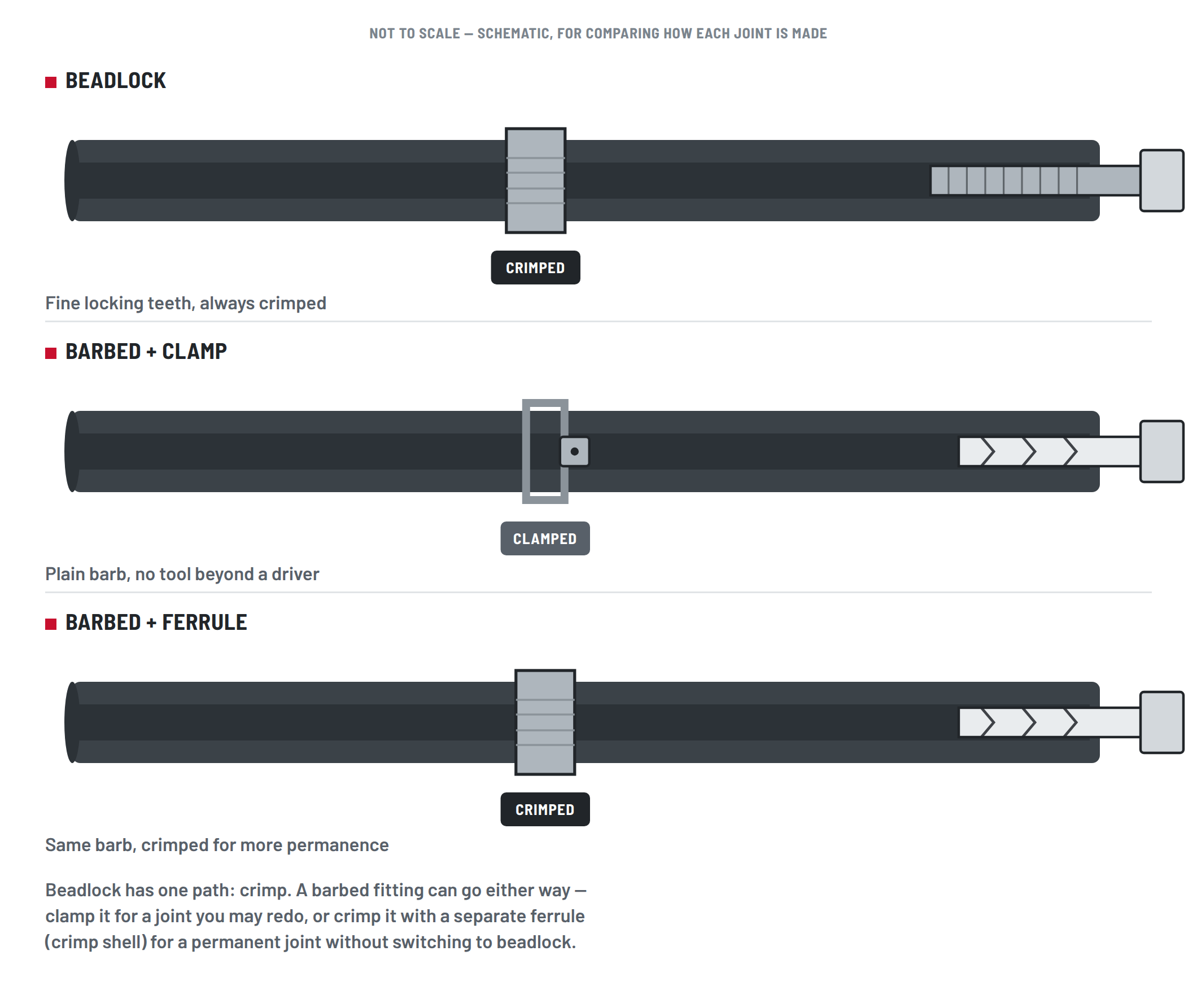
Both fitting types push their tube or stem into the hose bore. Where they differ is how the joint gets held together — and barbed actually gives you a choice, beadlock doesn't.
Crimped only, no other option
A beadlock fitting's tube has fine locking teeth, and a ferrule crimped down over the outside of the hose is what compresses the hose onto those teeth. There's no clamp version — crimping is how a beadlock joint is made, period. Done correctly, it's a permanent, one-time connection and what almost every OEM and shop-built hose assembly uses.
Clamped, or crimped with a separate ferrule
A plain barbed stem pushes into the hose bore, and you can secure it either way: a hose clamp tightened over the barb — no tool beyond a screwdriver or nut driver, fully field-serviceable — or a separate ferrule (crimp shell) crimped over it for a more permanent joint. Clamped is what makes barbed the field-repair option; crimped barbed is closer to beadlock in permanence, but it's still a plain barb underneath, not beadlock's locking teeth.
Match the fastening to the job
Need it removable, or you're working without a crimper: barbed with a clamp. Want a crimped joint but don't want to commit to beadlock: barbed with a ferrule. Want the most permanent, OE-style joint: beadlock.
Why mismatching a fitting and a hose causes leaks
A crimp or a clamp doesn't fail because the fitting or the hose was bad on its own — it usually fails because the two weren't matched to each other, or the joint wasn't made correctly for that combination. Three patterns cause most of it:
Wrong Size on the joint
A barb or a beadlock tube sized for one hose Size, forced onto a different Size hose, either doesn't seat to full depth in the bore or doesn't get gripped by the full width of the clamp or ferrule. It can look tight going together and still leak once the system is pressurized and cycling.
Wrong barrier type under the ferrule
Standard-barrier and reduced-barrier hose have different wall constructions. The crimp die, the ferrule, and the hose all have to be matched as a set — a ferrule crimped for one wall thickness onto the other can leave the joint under-compressed (loose, leaks under pressure cycling) or over-compressed (cuts into the tube). If you're not certain which barrier type a length of hose is, don't guess and crimp anyway.
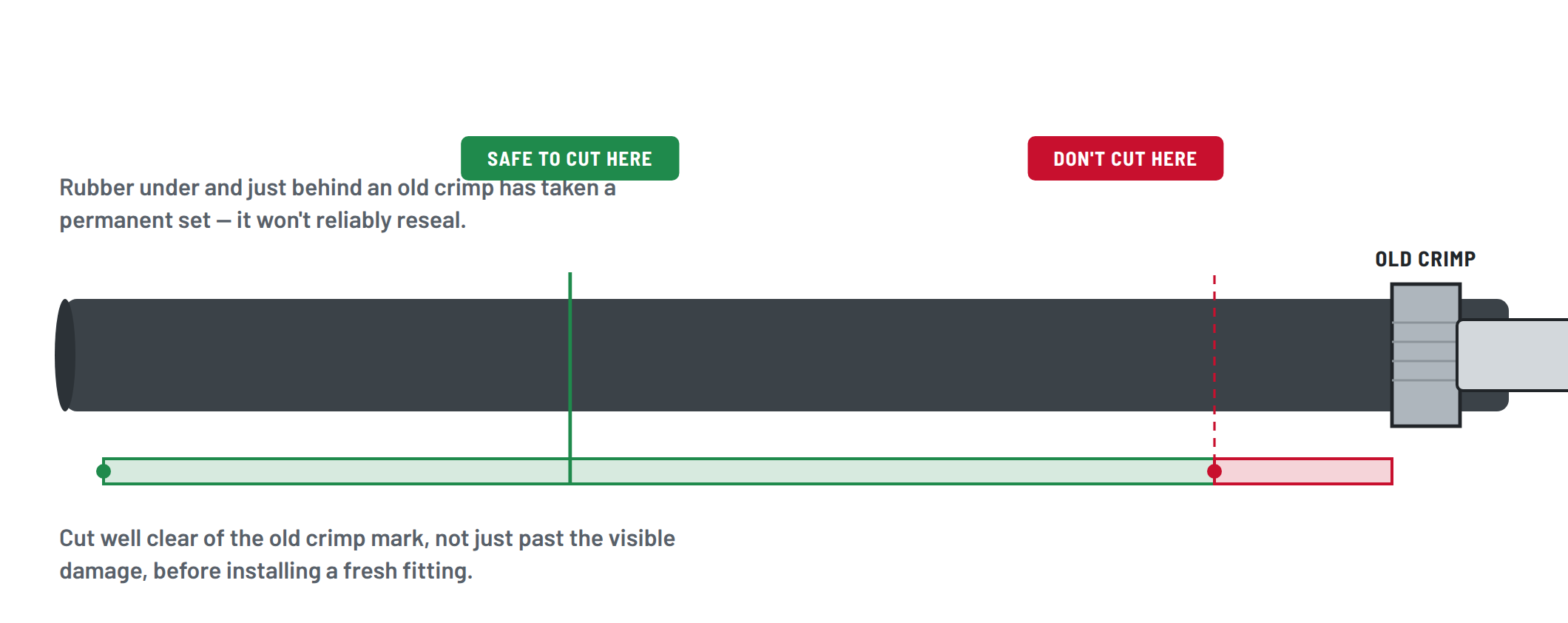
Reusing hose that's already been crimped
Rubber that's been compressed under a ferrule for a long time takes a permanent set in that spot. Cutting back a few inches and crimping a fresh fitting onto hose that was right next to an old crimp doesn't reliably reseal — cut back well clear of the old crimp mark, not just past the visible damage.
Installing a barbed fitting dry is a common cause of a split liner. Pushing a bare steel barb into a hose bore with no lubrication can bunch up or tear the inner liner before the fitting is even fully seated, and that damage is invisible once the clamp goes on. Lubricate the bore first.
Which one for which job
Beadlock — shop-built and permanent runs
Default choice for a hose assembly built on the bench: engine bay lines, condenser-to-compressor runs, anything that's staying in the vehicle for the long haul. Needs a crimper and the correct dies for the Size and barrier type, but gives you the most permanent, OEM-style joint.
Barbed — field repairs, or a crimped joint without going full beadlock
Clamped, it's the field-repair option: no crimper needed, nothing more than a screwdriver, and it can come apart and be redone. Crimped with a separate ferrule (crimp shell) instead of a clamp, it's more permanent — a middle ground between a quick clamp job and switching to a beadlock-body fitting.
Matching fitting to hose
Match by Size number (#6, #8, #10, #12), not by measuring the barb or tube with a caliper and guessing — the beadlock tube and a barbed fitting's stem are different diameters at the same Size, because they seal against the hose in different ways. See A/C Fitting Sizes Explained for how the Size, Tube Size, Thread and Hose numbers relate.
And match by barrier type. Standard barrier hose is the stated recommendation for most jobs; reduced barrier exists for tight routing or to match what a particular vehicle came with. Whichever you use, the hose, the fitting, and the crimp die all need to be the same barrier type — don't mix them.
Beadlock and barbed fittings, #6–#12
Straight and 90° versions of both, in all four common sizes, plus the clamps and ferrules a barbed joint can use.
Not sure which you need?
Building a full hose assembly? See our custom hose building & repair page, or the crimper kits under hose crimpers & MFG tools.
Beadlock vs. barbed FAQ
Can I use a barbed fitting anywhere I'd use a beadlock fitting?
Does a barbed fitting always use a hose clamp?
Why did my crimped fitting leak even though it looked tight?
Do I need to lubricate a hose before pushing on a barbed fitting?
Can I reuse a length of hose that already had a fitting crimped onto it?
Does the fitting Size number mean the same diameter for beadlock and barbed?
Does barrier type (standard vs. reduced) matter for the fitting too?
Building or repairing a hose assembly?
Beadlock and barbed fittings, hose clamps, crimpers and dies, and Goodyear barrier hose by the foot or the roll. Call with your Size and barrier type if you're not sure which fitting matches your hose.
Related reading: A/C Fitting Sizes Explained: #6, #8, #10 and #12 · How to Build a Custom A/C Hose: Measure, Cut, Crimp, Check · How a Car A/C System Works, Component by Component